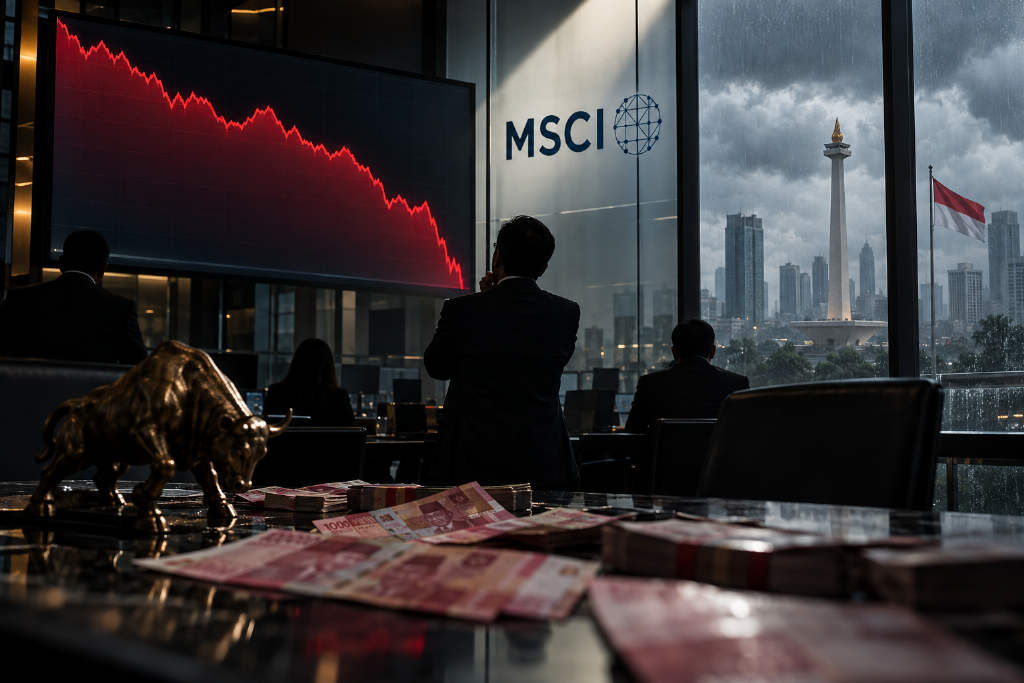
MSCI2026-10-19 04:02:29MSCI proposes removing Indonesia from emerging markets as Jakarta stocks sink againMSCI has opened a consultation on reclassifying Indonesia from an emerging market to a standalone market, a move that could remove the country from major global equity benchmarks. The index provider said keeping Indonesia in the emerging markets category is no longer appropriate, citing persistent concerns over investability, opaque ownership structures, suspected coordinated trading, and a lack of evidence that reforms have been enforced consistently across the market. Indonesian authorities had announced measures including disclosure of shareholders with stakes above 1%, more detailed investor classification disclosure, high shareholding concentration reporting, and a roadmap for a minimum 15% free float, but MSCI said institutional investors still saw limited progress. The market reaction was sharp. After the announcement, the Jakarta Composite Index fell 8% at the open on Oct. 16, triggering a 30-minute trading halt, and at one point dropped more than 11%, according to Bernama. On Oct. 19, the index fell more than 5% again, reaching its lowest level since early October 2020, CNBC reported. Goldman Sachs estimated that a full removal from the MSCI Emerging Markets Index could trigger about $5.6 billion in passive outflows. The bank also said a separate scenario in which FTSE Russell follows could lead to another $2.7 billion in outflows, while active funds benchmarked to MSCI and FTSE hold more than $8 billion in Indonesian equities.160
Bitcoin treas2026-07-04 00:30:14Why Strive Is Challenging MSCI’s Plan to Exclude Bitcoin Treasury CompaniesStrive Asset Management is pushing back against a proposal from index giant MSCI that could exclude companies whose bitcoin holdings exceed 50% of total assets from major equity benchmarks. In a letter to CEO Henry Fernandez, Strive argued that the proposal would create inconsistent outcomes across jurisdictions because bitcoin is reported differently under U.S. GAAP and IFRS. The firm says broad benchmark indexes should remain neutral and that investors who want to avoid digital-asset exposure can already choose optional “ex-digital-asset treasury” index variants, similar to customized index products used in sectors such as energy and tobacco. The debate matters because the proposal could affect not only Strive, which holds more than 7,500 BTC and ranks as the 14th-largest public corporate bitcoin holder, but also much larger players such as Strategy, with 650,000 BTC on its balance sheet. JPMorgan estimates that exclusion from MSCI indexes alone could trigger roughly $2.8 billion in passive outflows from Strategy, with that figure potentially rising to $8.8 billion if other index providers adopt similar rules. Strive argues that many bitcoin-heavy companies are real operating businesses in areas such as AI data centers, structured finance, cloud infrastructure, and mining-related energy and compute services. MSCI is expected to announce its decision on January 15, 2026, ahead of its February index review. The controversy has widened after Michael Saylor argued that Strategy should be viewed as a publicly traded operating company with a $500 million software business and a bitcoin treasury strategy, rather than as a fund, trust, or holding vehicle. At stake is more than index methodology: the outcome may shape how traditional finance classifies bitcoin treasury firms and whether passive investment benchmarks remain neutral as more public companies adopt BTC on their balance sheets.610
MSCI2026-07-04 00:00:14Why Strive Is Challenging MSCI’s Plan to Exclude Bitcoin-Heavy Public CompaniesStrive Asset Management has publicly opposed a proposal from MSCI that would exclude companies holding Bitcoin worth more than 50% of total assets from major equity benchmarks. In a letter to MSCI CEO Henry Fernandez, Strive argued that the proposal could create inconsistent treatment across global markets because companies report Bitcoin differently under U.S. GAAP and IFRS. The firm said this would undermine index neutrality and effectively impose an investment judgment on benchmarks that are supposed to reflect the market rather than shape it. Strive also urged MSCI to use optional “ex-digital-asset treasury” index variants instead of changing the eligibility rules for broad market benchmarks. According to Strive, similar customized index approaches already exist in sectors such as energy and tobacco, making a broad exclusion unnecessary. The stakes are high for Bitcoin treasury companies and operating businesses with large BTC holdings, including Strategy, which reportedly holds 650,000 BTC. JPMorgan estimates that MSCI exclusion alone could trigger $2.8 billion in passive outflows from Strategy, with the number rising to $8.8 billion if other index providers follow. The debate also touches on broader issues: whether a 50% threshold is workable, how to classify companies that run real businesses while holding large Bitcoin reserves, and whether strict index rules could push innovation away from U.S. public markets. MSCI is expected to announce its decision on January 15, 2026, ahead of its February index review.600
Michael Saylo2026-07-03 23:00:14Michael Saylor Defends Strategy’s Bitcoin Model Amid Index Removal FearsMichael Saylor has rejected concerns that Strategy (MSTR) could face major passive outflows if MSCI excludes the company from key equity indices. In comments posted on X, Saylor argued that Strategy should not be viewed as a fund, trust, or holding company, but as a publicly traded operating company with a roughly $500 million software business and a treasury model that treats Bitcoin as productive capital. He also highlighted five public offerings of digital credit securities — $STRK, $STRF, $STRD, $STRC, and $STRE — with more than $7.7 billion in notional value, positioning the firm as a builder and operator of Bitcoin-linked financial products rather than a passive asset holder. The debate intensified after JPMorgan analysts warned that an MSCI exclusion could trigger $2.8 billion in passive outflows, potentially rising to $8.8 billion if other index providers follow. At the same time, Saylor continues to present a far larger vision: building a $1 trillion Bitcoin balance sheet, growing it by 20% to 30% annually, and using it as the foundation for a new Bitcoin-backed credit system, savings products, money market funds, and insurance services. With Bitcoin near $80,000 after recently trading above $126,000, and MSTR at $167.95 after a sharp multi-day decline, the company now sits at the center of a broader battle over how Bitcoin-heavy public companies should be classified in global capital markets.580
Strive Asset 2026-07-02 15:00:14Strive Asset Management Urges MSCI to Reconsider Bitcoin Index ExclusionStrive Asset Management, co-founded by Vivek Ramaswamy, has written to MSCI opposing its proposal to exclude companies with over 50% of total assets in bitcoin from major equity indexes. Strive warns that different accounting treatments under U.S. GAAP and IFRS could lead to inconsistent outcomes for similarly exposed firms. The proposal could trigger an estimated $2.8 billion in passive outflows from Strategy (650,000 BTC) alone, rising to $8.8 billion if other index providers follow. Strive urges MSCI to use existing optional 'ex-digital-asset treasury' index variants instead of redefining eligibility for broad benchmarks, arguing the rule departs from index neutrality and should let the market decide. MSCI plans to announce its decision on January 15, 2026.640
Bitcoin Treas2026-07-02 14:45:14Strive Asset Management Urges MSCI to Rethink Bitcoin Index ExclusionStrive Asset Management has publicly opposed MSCI's proposal to remove companies holding over 50% of their total assets in Bitcoin from major equity indices. The firm criticizes the threshold as 'unjustified, overbroad, and unworkable,' highlighting accounting discrepancies between U.S. GAAP and IFRS that could lead to inconsistent outcomes. JPMorgan estimates that excluding Strategy alone could trigger $2.8 billion in passive outflows, potentially rising to $8.8 billion if other index providers follow. Strive recommends using optional ex-digital-asset treasury index variants to maintain neutrality. MSCI is set to announce its decision on January 15, 2026.560